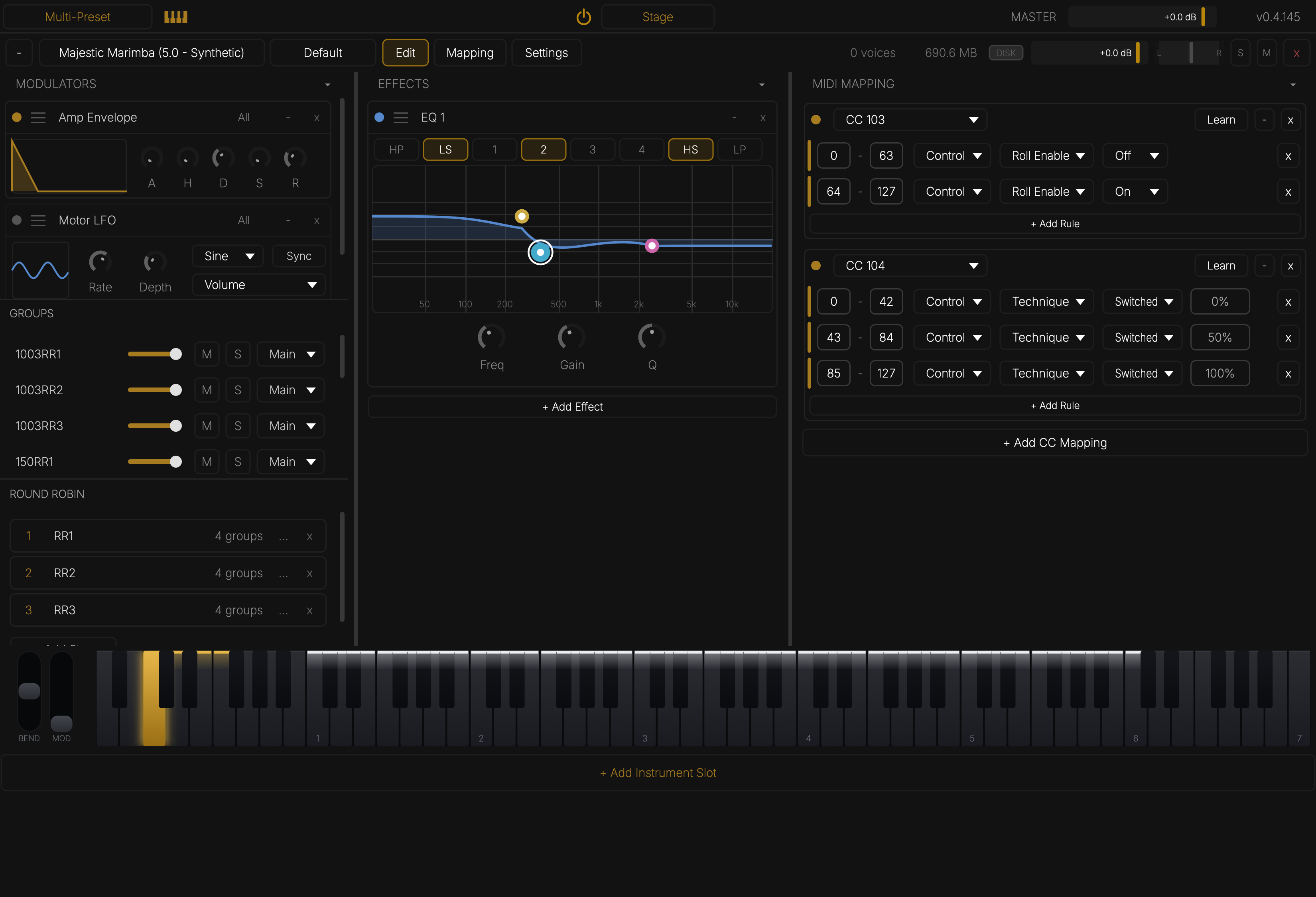
The Edit Tab

Edit opens the sound-design page: groups, modulators, effects, MIDI mapping, and round robin. This is where an instrument's behaviour is programmed — and everything here saves into the preset.

Edit tab

Groups

Every sample zone belongs to a named group (e.g. 1006RR1, 1006DryRR1 — one group per mallet, articulation, and round-robin variation). The group rack gives each group a volume, Mute, Solo, and an output bus. Groups are the currency the rest of the engine trades in: keyswitches enable them, round robin rotates them, and MIDI mapping rules allow or disallow them.

Modulators

Modulators can target all groups or a chosen subset (All / – selector on the header), so one instrument can hold, say, separate envelopes for wet and dry samples.

Effects

+ Add Effect builds a per-instrument chain. The EQ offers HP/LP, shelves, and four parametric bands with a draggable response display. Effects can be switched by MIDI mapping rules with per-note semantics — a keyswitch can turn on a low-pass EQ that affects only new notes, leaving ringing notes untouched (a felt-mallet emulation, for example).

MIDI Mapping

The MIDI mapping rack is the instrument's rulebook: each mapping listens to a CC (or a keyswitch) and runs its rules whenever a value arrives. A rule is:

value range min–max → action → target groups / modulators / effects

Actions:

Action Effect
Allow / Disallow Gate which groups can start new notes (ringing notes are untouched)
Release Immediately release all voices in the target groups
Mute / Unmute / Toggle Hard-mute groups (affects ringing notes too)
Solo / Unsolo / Toggle Solo groups
Parameter Drive a parameter continuously — including Sustain Pedal, Sustain Pedal (Gated), and EQ Enabled/Disabled

Learn binds the mapping to the next CC you move.

The classic vibraphone pedal setup

Wet (pedal-up-sustaining) and dry (damped) samples live in separate groups, and CC64 picks between them:

These rules are already programmed into the factory vibraphone presets — the Pedal preset variant answers CC64 exactly like a real damper bar.

Sustain pedal targets

For single-sample instruments there are two pedal behaviours under the Parameter action:

Nothing responds to CC64 unless a mapping says so — a marimba will never be muted by a stray pedal from the host.

Round Robin

Round-robin steps are sets of groups that rotate per strike, so repeated notes cycle through alternate recordings. During rolls the rotation applies per re-strike. Steps are chosen randomly (never the same twice in a row) and intersect with whatever the active keyswitch allows.